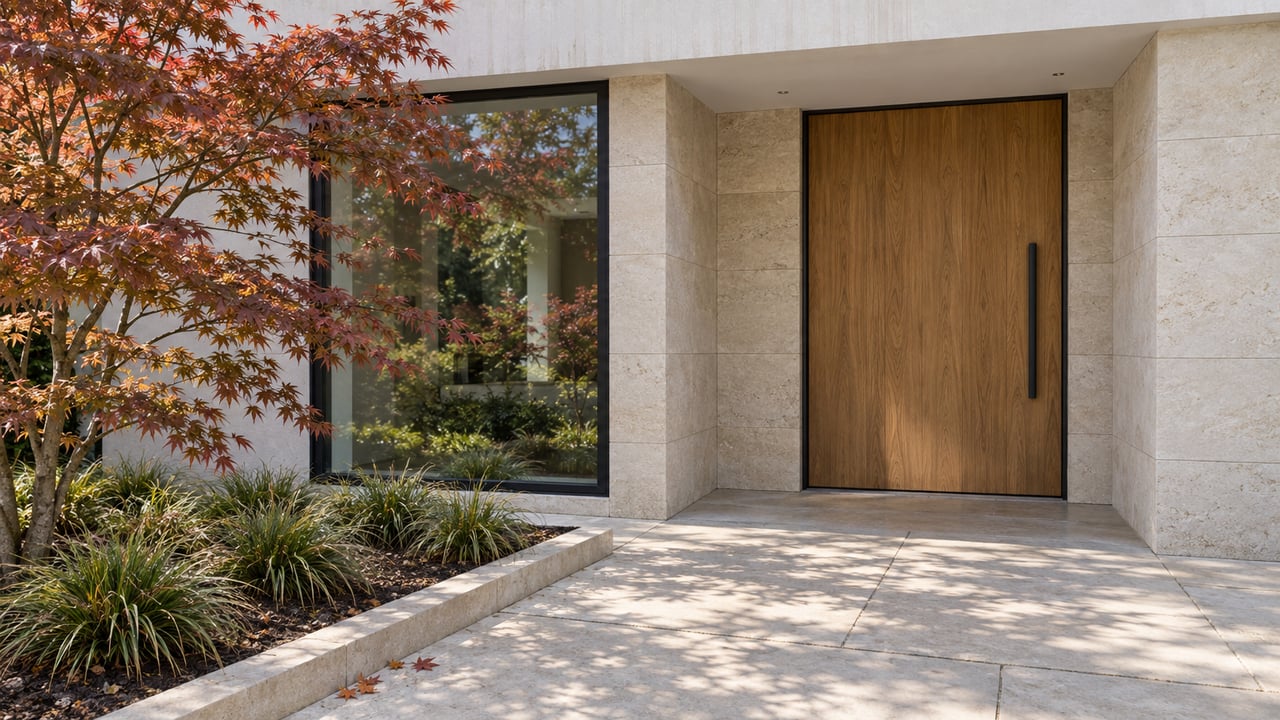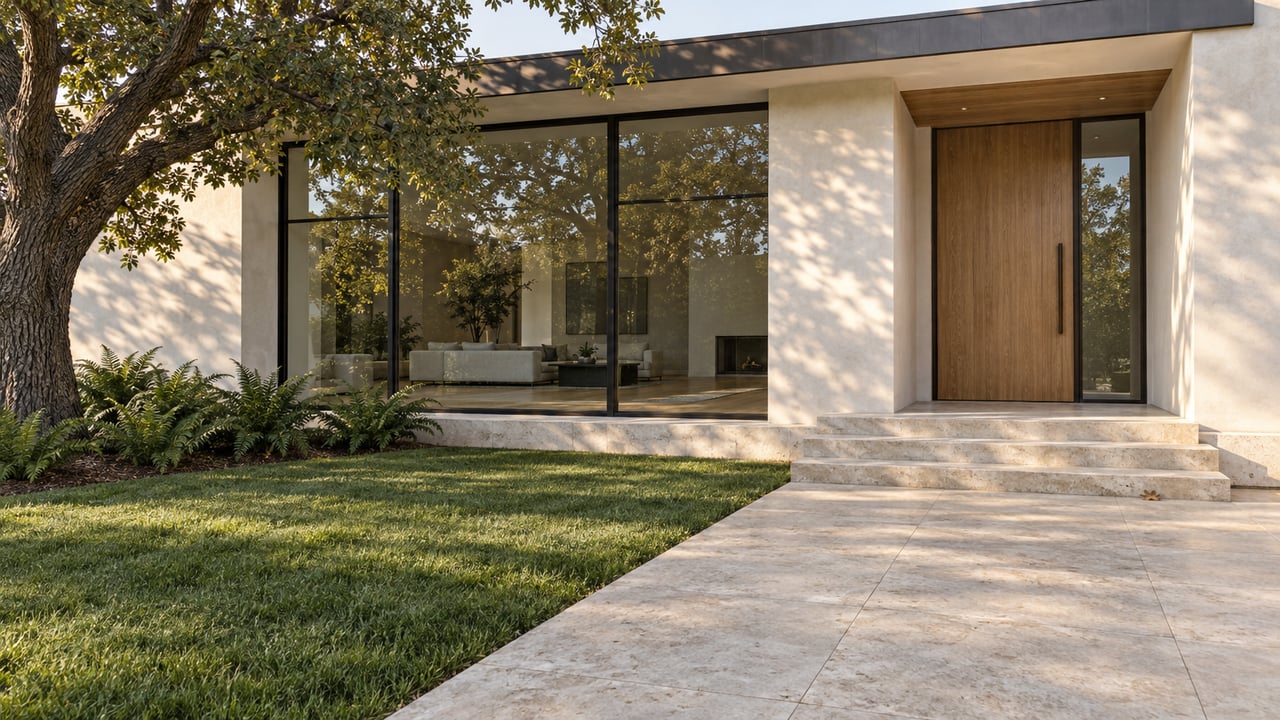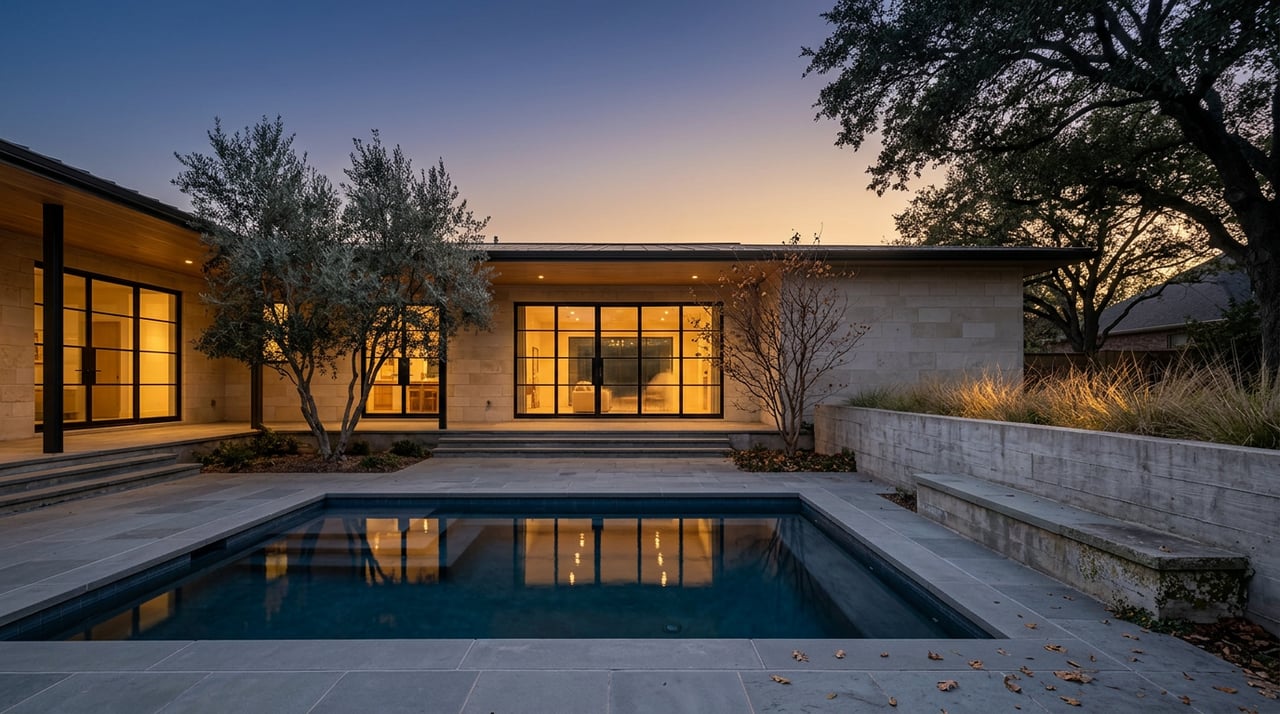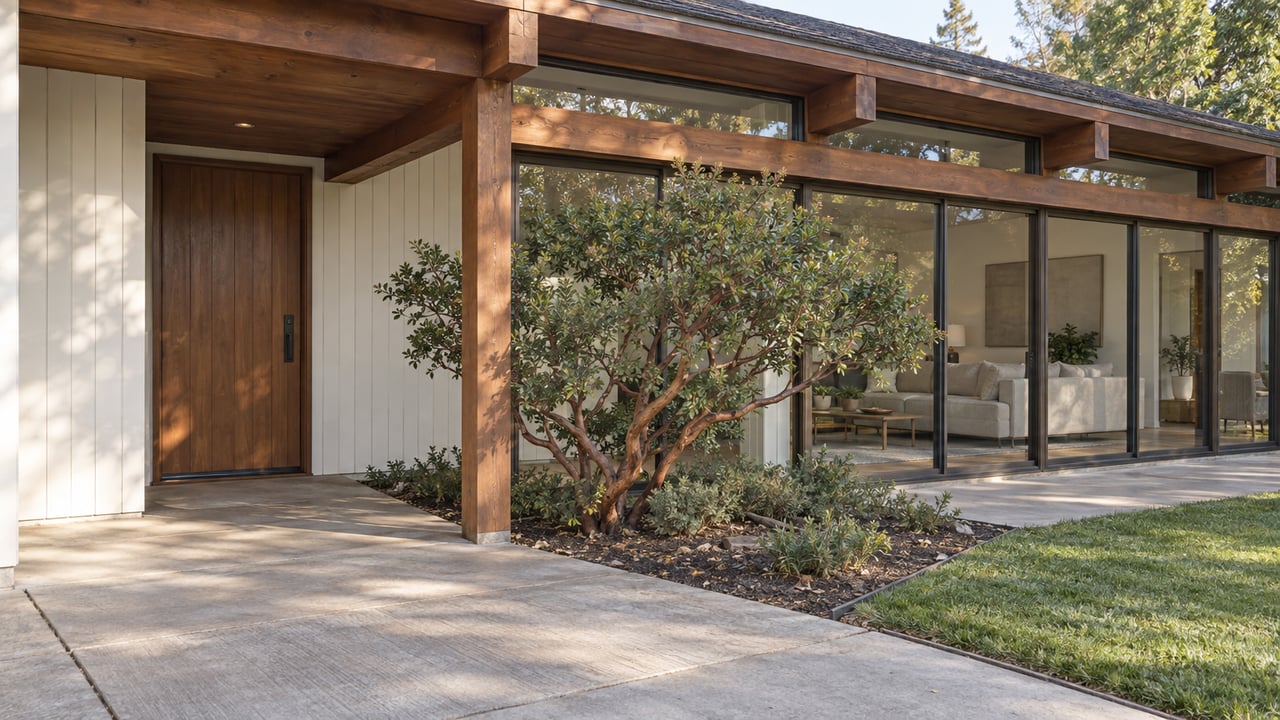
Fallen Leaf Lane curves through Los Altos without a sidewalk in sight, a quiet, tree-shaded street. The houses along it sit low behind fences, flat roofline after flat roofline, post-and-beam frames holding up walls of glass that face inward toward private atriums instead of outward toward the street. This is Fallen Leaf Park, 37 homes built in 1967 and 1968 on what used to be the Clay Ranch cherry orchard, and it is one of exactly two Eichler tracts in Los Altos.
The other is Parsons Way, eight homes on a small cul-de-sac off San Antonio Road, completed in 1974 as one of Joseph Eichler's final projects before his death that same year. Between the two tracts, plus a handful of custom-built Eichlers scattered through South Los Altos and Los Altos Hills, the total count sits at roughly 50 homes. That scarcity is the whole story here. A property type this rare does not behave like the rest of the Los Altos market, and a buyer or seller who treats an Eichler transaction like any other listing in town is working from the wrong playbook.
Fifty houses, one late chapter
Most people who know the word Eichler picture the smaller, plainer tract homes built across Palo Alto and Sunnyvale in the 1950s, thousands of them, priced originally as starter homes for young families. Los Altos never got that version. Its Eichlers arrived at the tail end of the builder's career, and they show it. Fallen Leaf Park includes rare five-bedroom floor plans running up to 2,600 square feet, with some models featuring large enclosed "gallery" or "loggia" spaces between the atrium and rear courtyard, a design flourish specific to architect Claude Oakland's later work. The lots average 10,000 square feet, larger than a typical Eichler parcel, and utilities run underground, which keeps the streetscape clean of overhead wires. Parsons Way homes sit on lots over 10,500 square feet with similar four-and five-bedroom layouts.
The practical effect is that comps from other Eichler neighborhoods do not transfer cleanly here. A 1950s Eichler in Palo Alto and a 1968 Eichler in Fallen Leaf Park share a design language, but they are different products with different floor plans, different lot sizes, and different systems inside the walls. Anyone pricing or evaluating a Los Altos Eichler needs data from these two specific tracts, not the broader Eichler market.
The school district line runs through the middle of the niche
Here is the detail that surprises even people who think they understand this pocket of the market. The two Eichler tracts in Los Altos sit in different school districts entirely.
Parsons Way is assigned to the Los Altos School District for elementary and middle school, feeding into Los Altos High School, the standard pattern for most addresses inside the city. Fallen Leaf Park is not. That tract is assigned to Cupertino Union School District for elementary and middle school and Fremont Union High School District for high school, feeding into Montclaire Elementary, Cupertino Middle School, and Homestead High School. Both tracts carry a Los Altos mailing address. Both sit inside city limits. The district assignment does not follow the city line, and a buyer who assumes a Los Altos address means a Los Altos School District assignment would be wrong for the larger of the two tracts.
This is not a claim about which schools are better. It is a boundary fact, and boundary facts do not move for anyone's convenience. The city of Los Altos lists all of the districts that touch its borders on its own site, and confirming an exact address against the current attendance map before writing an offer costs nothing and takes a few minutes. Skipping that step on a home this specific, in a niche this small, is the kind of oversight that surfaces at the worst possible time.
What the inspector finds under the slab
An Eichler inspection reads differently than a standard Los Altos inspection because the construction system is genuinely different. There is no attic. The radiant heating runs through pipe embedded in the concrete slab itself, meaning a leak is not a simple repair behind a wall but a decision about whether to cut into the foundation.
The material of that buried pipe matters enormously, and the age of the Los Altos tracts works in a buyer's favor here. Eichlers built before the late 1950s often used galvanized steel piping for radiant heat, a choice that led to a well-documented 1959 lawsuit over premature system failures. Los Altos's homes came later, built between 1967 and 1974, and use copper radiant lines instead, systems now roughly 52 to 59 years old. Copper holds up better than galvanized steel, but age is still age. A single isolated leak typically runs $500 to $2,500 to repair. A system with multiple leak points or a history of patch repairs often calls for a full PEX replacement, which runs $15,000 to $30,000.
A few other patterns show up consistently in these homes:
- Flat and low-slope rooflines are prone to ponding water, and foam roofing has become the standard modern fix rather than a like-for-like replacement.
- Original electrical panels were sized for 1960s power loads, a few outlets and lights per room, and bringing a home up to a modern 200 or 400-amp panel means running new wire through wall cavities or surface-mounted conduit, since there is no attic to hide the work.
- Bathroom ventilation was minimal in the original design, and adding proper exhaust fans means routing ductwork through the flat roof rather than a conventional attic path.
None of this makes an Eichler a risky purchase. It makes it a specific one, where a generic Los Altos home inspection checklist misses the questions that actually matter for this construction type.
The historic-district question nobody has answered yet
Since around 2016, residents of Fallen Leaf Park have pursued formal historic district status for their tract, aiming to prevent the kind of teardowns and mismatched second-story additions that have reshaped some neighboring Eichler enclaves in Palo Alto. As of 2026, that effort has not produced a formal designation, and the current status is genuinely unclear, with conflicting accounts of whether the push remains active. For context, two Palo Alto Eichler tracts have already been placed on the National Register of Historic Places, so the precedent for this kind of protection exists nearby even though Los Altos has not yet used its own historic district provisions on any neighborhood.
This matters for anyone on either side of a transaction. A buyer who wants freedom to add a second story or eventually rebuild is taking on different risk in a tract that could gain historic protections than in one that clearly will not. A seller marketing a Fallen Leaf Park home benefits from knowing exactly where that process stands rather than repeating an outdated assumption. The only reliable move is to ask the city's planning division directly what the current status is, since this is not something a portal listing or a standard disclosure package will spell out.
The review-date math breaks down when the pool is this small
Silicon Valley sellers commonly set a suggested offer review date, typically five to fourteen days after a home first goes live, giving buyers time to complete inspections and giving sellers a way to compare offers side by side rather than accepting the first one that arrives. Agents often gauge likely competition by tracking how many disclosure packages get downloaded before that date, since serious buyers tend to pull the full package rather than just browsing photos.
That system assumes a reasonably steady flow of comparable listings to calibrate against. An Eichler sale in Los Altos does not offer that. With only 37 homes in one tract and 8 in the other, a sale in either neighborhood can be a rare enough event that there is no recent, comparable transaction to point to for pricing or for gauging how many serious buyers are likely to show up. The review-date system still gets used, but the read on it has to come from direct knowledge of the tract itself, not from the kind of citywide sales data that works fine for a standard Los Altos ranch or rebuild.
Before writing an offer or accepting one on a Fallen Leaf Park or Parsons Way property, the questions worth answering directly are the same three that keep surfacing here: which school district actually serves this specific address, what condition the radiant heat system is in and what material runs through it, and where the historic-district conversation currently stands. None of those show up reliably in a standard listing.
If you're weighing a purchase or a sale in one of Los Altos's Eichler tracts, Hebe Li can walk through the specific diligence this niche calls for, from verifying school district assignment to reading what an inspection report on a slab-heated, attic-less home is actually telling you. Reach out to start that conversation.
This article is general information, not legal, tax or financial advice. Consult a qualified professional about your situation.