Pull up two different housing trackers for Los Altos Hills in the same month and you will get two different numbers for the median sale price, sometimes over a million dollars apart. That is not a data error. With only two or three dozen closings town-wide in a typical month, one large estate closing early or late can swing the median by seven figures. The number that actually predicts whether your escrow closes in three weeks or drags past six does not show up on any portal at all.
It is buried in three things a buyer rarely thinks to ask about before writing an offer: whether the septic system has room to grow, whether the private road has a funded maintenance agreement behind it, and whether the Heritage Oaks on the lot sit where you want to build. Each one is a documented, town-administered fact. Each one can add weeks to a closing that looked simple on paper.
The median is arguing with itself because the sample is tiny
In the three months ending May 2026, the median sale price across Los Altos Hills came in near $5.3 million, down roughly 9.5 percent from the same window a year earlier. Look at May 2026 in isolation on a different tracker and the median reads closer to $6.5 million. Both numbers are technically correct. Neither is stable, because the Town sells so few homes in any given month that the mix of what happened to close, not the underlying demand, drives the headline.
A more useful read comes from looking at how homes actually price against their own list price. Local trend analysis of MLS-reported sales shows that in recent quarters, roughly 30 to 50 percent of Los Altos Hills homes have sold under list, with the average sale-to-list ratio sitting close to 99 to 102 percent. That is not the picture of a market where every listing draws a bidding war. It is a market where the buyer pool for any single estate is small, and where the property itself, not the season or the median, decides how a sale goes.
That is the pivot worth making before you start touring: the variable that explains why one Los Altos Hills home closes fast and a comparable one sits for six weeks is not demand. It is what is underneath the house, on either side of the driveway, and over the roofline.
Septic capacity sets the construction ceiling before any offer is written
Most of Los Altos Hills is not on a municipal sewer line. The Town's own septic bulletin states plainly that a permit for an on-site sewage disposal system will only be issued where a sanitary sewer is not available within 200 feet of the building, and that on-site systems cannot be used at all if soil conditions, slope, or high groundwater make the site unsuitable. Confirming which side of that 200-foot line a specific parcel falls on is a five-minute records check that most buyers never make until it becomes a contingency problem.
If the property is on septic, the county's site evaluation process is not casual. It typically requires a soil profile trench excavated to at least 11 feet, observed in person by the county's Department of Environmental Health, before anyone can confirm the system will support the bedroom count you are planning. Drainfields are not approved at all on slopes over 50 percent, and any slope over 20 percent triggers additional investigation.
Then there is the calendar itself. The Town's septic requirements bulletin is direct about seasonal timing:
Septic system installation or repair work is prohibited between November 1 and April 1. Emergency repairs may be allowed with approval of an erosion control plan by the Town of Los Altos Hills.
A buyer whose contingency period lands in December and whose septic inspection turns up a needed repair is not looking at a quick fix. They are looking at a system that legally cannot be worked on until spring, absent an emergency exception.
Even after close, septic ownership carries its own maintenance obligations that differ from a sewered property. On parcels that are connected to the Town's limited sanitary sewer system, the Town confirms that the property owner is responsible for maintaining, repairing, and replacing the lateral from the building to the sewer main, including the Y-connection, the relief valve, and the backflow preventer. That is a cost line that does not exist on a flatland Los Altos property with full municipal service.
A private road is a small government you are joining
Many Los Altos Hills addresses share access over a private road, and the Town maintains and publishes an actual list of which streets in town are private and which are public, cross-referenced to the specific resolution that governs each one's maintenance status. This is not neighborhood folklore. It is formal town business with a paper trail.
Where a road is private, the Town provides a recorded Private Road Maintenance Agreement template that establishes a Road Commission Agent elected by the participating owners, a majority-vote threshold for approving road improvements above a set dollar amount, a dispute process that runs through binding arbitration rather than court, and an annual invoice cycle that funds a dedicated bank account for maintenance and emergency repairs.
None of that is a problem if the agreement exists, is current, and has a funded account behind it. It becomes a problem during escrow when a buyer's lender asks for evidence of a maintenance agreement and the seller cannot produce one, or when the agreement exists but the reserve account is empty and a repaving bill is coming. Asking for the recorded agreement and the last two years of dues and expenditures during the inspection period is the kind of question that separates a clean 30-day close from a stalled one.
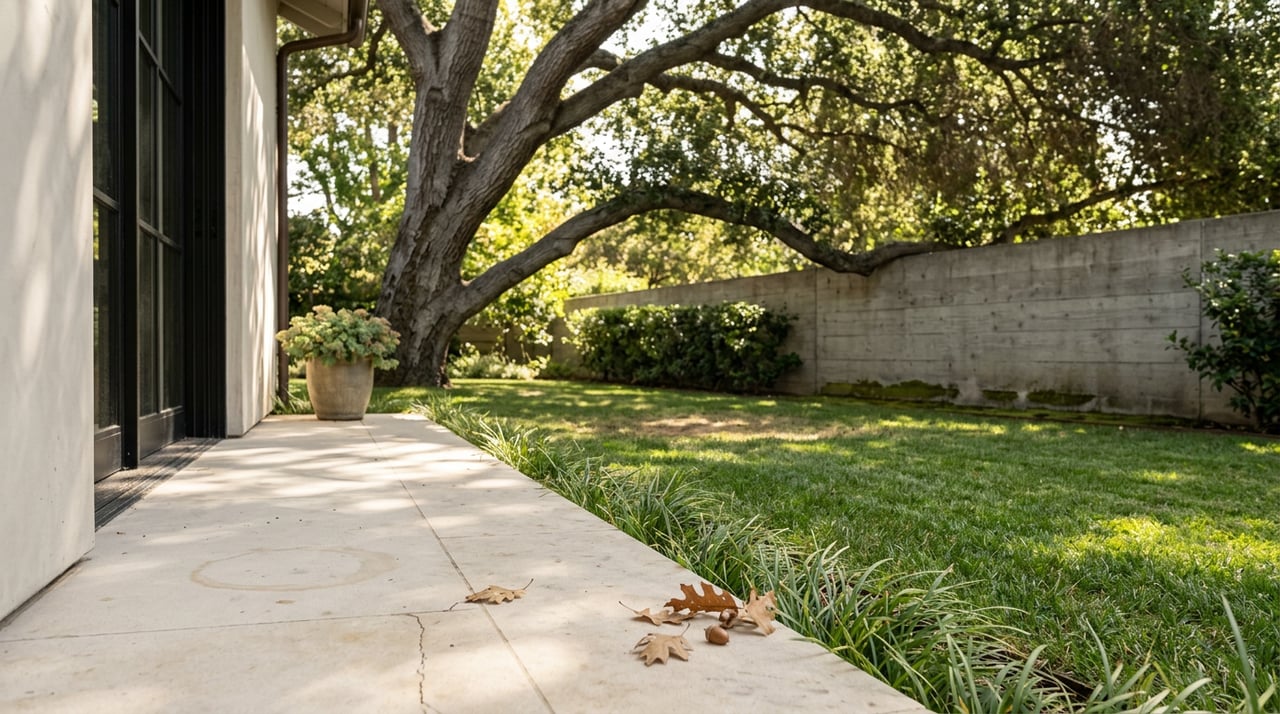
The oak canopy is a permitting constraint, not scenery
Los Altos Hills protects its oaks by ordinance, and the definition is specific enough to matter for anyone planning an addition, a pool, or an accessory dwelling unit near mature trees.
| Heritage Oak fact | Detail |
|---|---|
| What counts as protected | A quercus species (Valley, Live, Black, or Blue Oak) with a trunk 36 inches in circumference, about 12 inches in diameter, measured 4 feet above the root crown |
| Permit fee | $250, waived for a dead or immediately hazardous tree |
| Neighbor notice | Written notice to abutting property owners, with a 10-day window to protest before a permit can issue |
| Replacement condition | The Town may require up to five replacement trees for each Heritage Oak removed |
| Penalty for unpermitted removal | A fine up to $5,000 or the tree's assessed replacement value, whichever is higher |
That 10-day notice and protest window is worth planning around specifically. If a renovation or an ADU footprint requires removing a Heritage Oak, the tree removal permit process adds that window on top of ordinary plan review, and a protest from an abutting neighbor pushes the decision to a hearing. For new construction on a hillside lot, the Town's own residential building guide also requires foundation designs to be prepared by a licensed engineer and supported by a soils report, another document worth confirming exists for any property with a foundation older than the current code cycle.
Why this explains the widening days-on-market gap
Days on market in Los Altos Hills have stretched from an average of 9 days a year ago to 15 days more recently. That gap is easiest to explain not as cooling demand but as a split between two kinds of listings: parcels where the septic has documented spare capacity, the road agreement is funded and current, and the oaks sit clear of the building envelope, and parcels where a buyer's inspection period turns up one of those three unresolved. The first group moves fast. The second group is where the extra days accumulate, one soils report or one neighbor notice at a time.
The median price tells you what the town's homes cost on average. It tells you almost nothing about which specific parcel will close on schedule.
A short FAQ
Does every Los Altos Hills property have a private road and a septic system? No. Some parcels sit on Town sewer and public streets. The point is that a meaningful share do not, and confirming which situation applies to a specific address, before writing an offer, changes what your inspection period needs to cover.
If I want to add an ADU, does the oak ordinance actually slow things down? It can. If the planned footprint requires removing a Heritage Oak, the 10-day neighbor notice and possible protest hearing sits on top of standard permit review, not instead of it.
Who actually pays when a private road needs repaving after I close? The recorded maintenance agreement, not the county, generally obligates each participating owner through the Road Commission Agent's annual invoice. Confirming the agreement exists and the reserve account is funded is a due diligence item, not a formality.
If you are weighing a specific Los Altos Hills property and want to know what its septic history, road agreement, or oak inventory actually looks like before you write an offer, Hebe Li can walk through the parcel-specific due diligence with you. Let's Connect.